



Digital marketing and graphic design used to feel like separate worlds—one driven by strategy and analytics, the other by creativity and aesthetics. Today, they’re inseparable.
Algorithms on Google, Instagram, TikTok, Facebook, Pinterest, and even LinkedIn reward content that is visually clear, engaging, and easy to consume. Your design choices directly influence your digital performance metrics.
If you want higher click-through rates, longer dwell time, and more shareability, you can’t design only for people—you must design for the algorithm and the people using it. Understanding how visual content impacts SEO and social reach can help you make small design decisions that lead to big performance gains.
Algorithms are built to prioritize content that users find valuable, and they determine value by tracking behavior. They look at whether people stop scrolling, click through, stay on a page, share content, or return for more.
Every one of these actions is influenced by design. Strong visuals help users quickly understand your content and encourage deeper engagement, while weak or cluttered visuals cause users to disengage. When engagement drops, algorithms interpret that as a lack of relevance.
Click-through rate is one of the strongest signals of relevance across search engines and social platforms. Good design increases CTR by making your content instantly understandable and visually appealing.
A clear visual hierarchy helps users immediately grasp what the content is about, why it matters, and where to click. High-contrast thumbnails and images stand out in crowded feeds, increasing visibility and curiosity.
Readable text on graphics is equally critical—if text is too small, decorative, or poorly contrasted, users scroll past and algorithms take note. Consistent branding also plays a role, as familiar visuals build trust and encourage repeat clicks, which platforms reward.
Dwell time—how long someone stays on a page—is a major SEO signal. Google interprets longer dwell time as an indicator that content is useful and relevant.
Scannable layouts with short paragraphs, bold headings, visual breaks, and icons help users consume information more easily and stay engaged longer. Relevant images and graphics reinforce your message and improve comprehension.
Clean, readable typography prevents eye strain and early exits, while mobile-first design is essential. With over half of web traffic coming from mobile devices, layouts that don’t adapt well to smaller screens cause dwell time to drop sharply.
Shareability is the currency of social reach. When users share your content, algorithms push it further, increasing organic visibility.
Emotionally resonant visuals are especially powerful, as people tend to share content that makes them feel inspired, hopeful, entertained, or empowered.
Clean, bold graphics outperform cluttered designs because they’re easier to understand at a glance and more visually appealing in feeds.
Infographics and micro-graphics are particularly effective because they deliver value quickly, are easy to save, and look polished when reposted. Consistent branding increases shareability by making your content feel familiar and trustworthy.
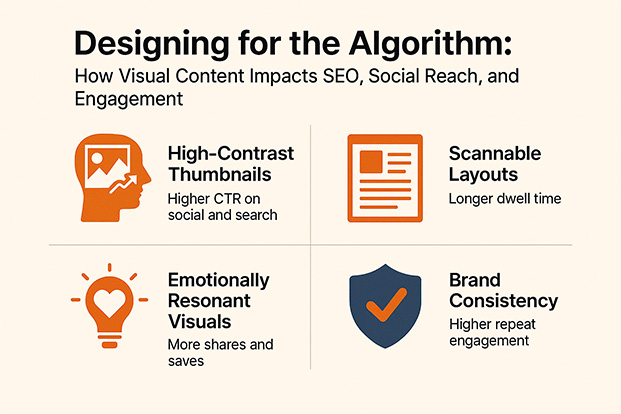
Design choices aren’t just aesthetic—they directly map to measurable outcomes. High-contrast thumbnails tend to increase click-through rates, while strong visual hierarchy leads to more clicks and longer dwell time.
Clean typography lowers bounce rates, consistent branding drives repeat engagement, emotion-driven imagery increases shares and saves, and mobile-optimized layouts support better SEO and lower drop-off. Infographics often result in higher shareability and more backlinks.
Designing for performance starts with understanding platform requirements. Using platform-specific image dimensions improves clarity and reach, while keeping text minimal helps avoid penalties on platforms like Facebook and Instagram.
Optimizing file sizes is critical for load speed, which directly affects SEO. Strategic use of alt text helps search engines understand your visuals and improves accessibility.
Testing and iterating based on performance data allows you to refine your visual style and consistently improve results.
As platforms evolve, algorithms will increasingly prioritize visual clarity, user engagement, brand consistency, and accessibility. Graphic design is no longer just an aesthetic discipline—it’s a performance discipline.
When you design for the algorithm, you’re ultimately designing for the user. And when users engage, algorithms reward you with greater visibility and reach.
© 2026 Vivid Dezigns LLC. All Rights Reserved.